








Some scenes are like a song: Their pacing builds and sings. They’re a pleasure to read, and all the more if they’re about a character I love.
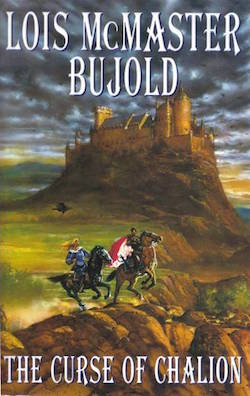
Lupe dy Cazaril (Caz, for convenience and by his preference) arrives home in the first book of Lois McMaster Bujold’s Chalion series, The Curse of Chalion, under inauspicious circumstances. He’s nobility (a “castillar”—a knight), but penniless. He’s a war hero, but one betrayed and sold into servitude. He has powerful enemies waiting for him at home, and a tortured past haunting his steps. He just wants to lie low for a while and recover.
Naturally, it’s not long before he finds himself the primary advisor to the rightful Royina of Chalion, seeking to cut through a web of treachery to restore her to the throne and at the same time end the curse upon her house through intellect, strength of character, and the somewhat dubious assistance of two separate gods.
Iselle, the rightful Royina, is subject to both the titular curse on her house and a grasping noble determined to make himself regent and steal the throne. Cazaril, however, has a singular solution to both problems: A wedding. Married off, Iselle will no longer be of the royal house of Chalion; married off, the noble can no longer steal the throne from under her feet. There’s only one appropriate partner for Iselle of Chalion: Bergon of Ibra, heir apparent to the neighboring kingdom. But neither Iselle nor Caz are willing to sell out Chalion to Ibra: the marriage will be one of equals, and the couple will rule their two countries separately. (The story of The Curse of Chalion is based, somewhat loosely, off the early lives of Isabella and Ferdinand. I say “somewhat loosely” because as far as I can remember the historical version of events does not include magical jaguars or demonic abdominal cancers, and if you want that sentence to make sense, you are going to have to go and read the book yourself.) The only thing standing in the way of the marriage is Bergon’s father, a notoriously crafty Roya known, appropriately, as The Fox.
Cazaril and The Fox begin negotiations over an expensive chessboard. The Fox opens by remarking on the faith Iselle has placed in Cazaril, which enables him to sign a contract in her name without consulting with her first. The Fox tests the waters, proposing changes to a few of the clauses in the marriage contract in order to make it more beneficial to The Fox and Ibra. Each time, Cazaril gently persuades The Fox against the revision, and the contract stands as is.
Diverted but not dissuaded, The Fox gets serious:
[…] the Fox spoke of an elegant villa overlooking the sea, and placed a coral castle piece upon the table between them. Fascinated to see where this was going, Cazaril refrained from observing how little he cared for the sight of the sea. The Fox spoke of fine horses, and an estate to graze them upon, and how inappropriate he found Clause Three. Some riders were added. Cazaril made neutral noises. The Fox breathed delicately of the money whereby a man might dress himself as befit an Ibran rank rather higher than castillar and how Clause Six might profitably be rewritten. A jade castle piece joined the growing set. The secretary made notes. With each wordless murmur from Cazaril, both respect and contempt grew in the Fox’s eyes, though as the pile grew he remarked in a tone of some pain, ‘You play better than I expected, Castillar.’
When the Fox has finished, Caz gently reveals the truth: He is dying from cancer, and as such cannot be bribed.
 I enjoy characters that possess intelligence and poise under pressure, which is why Ivan in my novel Lightless spends hundreds of pages chained to a chair trying to talk himself out of trouble. Cazaril isn’t in quite the same boat—for one thing, he’s got much nobler motivations—but he has both qualities in abundance and shows them off here, for Cazaril’s talents are not in warfare (though he is a very accomplished soldier), but in diplomacy. He keeps his own counsel, possesses a dry but gentle sense of humor (“Fascinated to see where this was going, Cazaril refrained from observing how little he cared for the sight of the sea.”), and manages to pull off a marriage negotiation despite the fact that he does not, in fact, negotiate. (In the end, The Fox accepts the contract without any revisions at all.) Cazaril’s most noble qualities, his kindness and his loyalty, shine as well: Though offered uncountable treasures, Caz never wavers in his devotion to Iselle. We see in this scene why Cazaril was chosen as a goddess’s champion to end the curse on Iselle’s house—however little Cazaril might enjoy the side effects of having been chosen. (I did mention the demonic abdominal cancer, didn’t I? Every night it screams, but only Caz can hear it.)
The Fox, too, is impressed; both by Cazaril’s skill as a diplomat and his unexpected loyalty. It’s this moment that convinces the notoriously scheming roya to wholeheartedly support his son’s marriage to Iselle and thereby her claim to the throne of Chalion—a great victory, even if, as Cazaril soon learns, the curse cannot be so easily defeated. At the end of the scene The Fox attempts to offer Cazaril gifts once more, this time out of respect, and once more, Caz politely refuses.
“Do you truly want nothing for yourself, Cazaril?” The Fox asks.
Cazaril only replies, “I want time.”
 C. A. Higgins writes novels and short stories. She was a runner up in the 2013 Dell Magazines Award for Undergraduate Excellence in Science Fiction and Fantasy Writing and has a B. A. in physics from Cornell University. The Lightless trilogy—Lightless, Supernova, and the just-released conclusion, Radiate—is published by Del Rey.

Chalion is really a great book, and Paladin of Souls, the sequel, is even better. The new and ongoing Penric and Desdemona series is also incredible!
This and its “sequel” Paladin of Souls are two of my favorite books of all time. The world building, the characters, and their stories – all wonderful.
A castillar is actually a baron in Bujold’s world.
Iselle isn’t the rightful Royina until the very end of the book, so Caz rapidly finds himself advisor to a Royesse not expected to inherit her family’s throne, not a Royina. He doesn’t have to restore her to her throne because she doesn’t have a throne yet; everyone was anticipating her marrying outside Chalion to secure an alliance for the males in her family, as you’d expect of a princess in a feudal system. It’s a leopard, not a jaguar, and as DG @3 says, castillar appears to correspond more closely to “minor baron” than “knight”, especially given the obvious linguistic echo of the word “castellan”.
That said, this is one of my favourite books.
I guess I’m going to have to reread these two books. I’ve read the rest of her books so many times, but not these! I’m loving Penric, set in the same world.
I’d read the phone book if Bujold had written it! Great characters, world building, and one of the very best wordsmiths!
I’m excited to see this here!
As my husband pointed out in his recent nth re-read, Caz has quite the reputation before this too. One wonders why the Fox was even trying to bribe him, considering.
Oh I love this book. I’ve struggled to really get into Bujold for some reason(I’m sorry, you all!!), but this is the one that still sits on my shelf – it was love at first read. I suppose I really should read Paladin of Souls then?
One of my favorite novels of all time, and the world Bujold built is phenomenal! Glad to see that this novel still gets reviewed/noticed/loved.
Cazaril is perhaps my favorite fictional character ever. He’s deeply competent, but tends to dismiss his own competence because so many of his efforts (through, from an outside perspective, no fault of his own) end up failures. He has a strong moral center, but he’s been through too much to maintain his faith in abstract ideals of honor, nobility, and so on. He’s self-sacrificing, almost to a fault, but he’s not a drama queen about it. He just wants to quietly do the right thing, which leads him inexorably (but not accidentally, because the gods are parsimonious) into the central moral and political crisis of his generation. He’s definitely the hero I would want to grow up to be.
(And the theology! Seriously, if you want a respectful and thoughtful reading of a polytheistic world that doesn’t involve lots of showy magic and is realistic about things like sectarian differences and loss of faith, read this book. And then read Paladin of Souls, which is a little more showy on the magic side but equally deep in characterization and worldbuilding.)
@6: My guess is that the Fox knows Cazaril by reputation for the military defense of Gotorget; only Caz’s intimates (like Palli) would have been privy to his refusal of the Roknari bribes, and so the Fox would assume that he’s a man like other men, and try to buy his loyalty (the same way that Dondo tried, with as much success).
I wonder how much of Curse has been retconned given the portrayal of demons in Paladin of Souls and the Penric Novellas. Regardless, the audiobooks for all of them are quite good.
I adore Caz and his poor attempts to just try and get along while being yanked around by parsimonious deities.
@9 Worship of the Five Gods is the only fictional religion I’d actually convert to. I enjoy how Saints tend towards exasperated annoyance and/or fondness towards their gods while everyone else is reverent and awestruck. The god-touched just shake their heads and go, “if you only knew.”
@11: A good question, though given the special purpose of that particular demon and the complicating factor of Dondo, I think you can get away without retconning *too* much.